
What factors mediate variation in introgression between recently diverged taxa?
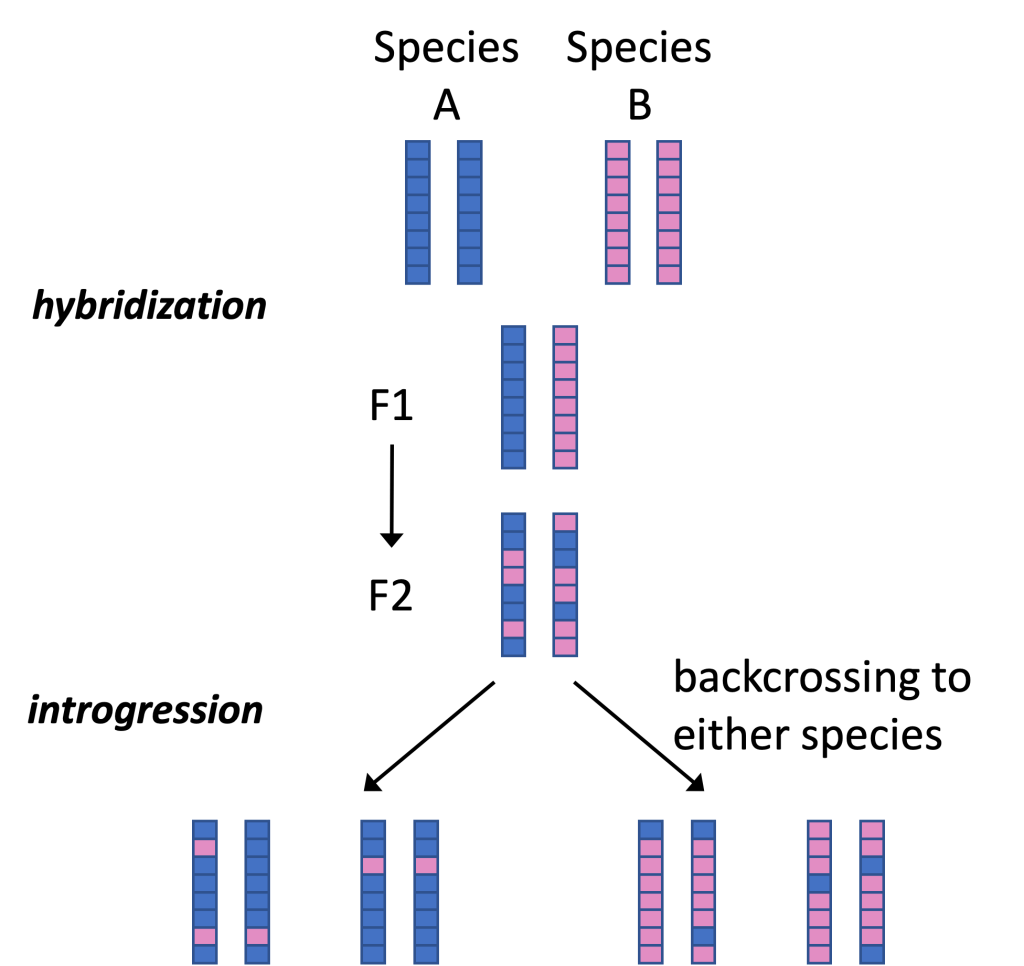
Secondary contact occurs when ranges of lineages that have been diverging in allopatry shift and overlap. The interaction between these taxa is thought to be the final test of speciation, wherein taxa may hybridize and form a hybrid swarm, may outcompete one another, or may coexist. Even with stable coexistence, there is the opportunity for hybridization and gene flow, i.e., introgression, to move genetic material from one taxon to another.
Speciation genomics over the past decade has shown that hybridization and introgression are common evolutionary phenomena. We’re now interested in understanding variation in introgression – how it varies across different levels of organization (genomes, individuals, populations) and why.
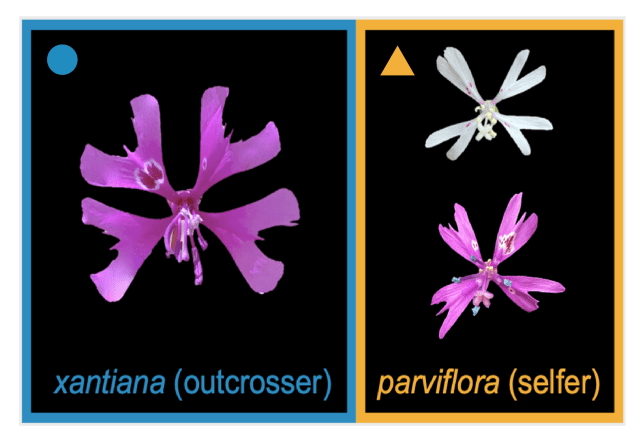
Towards this end, I’ve been collaborating with Yaniv Brandvain and Dave Moeller at the University of Minnesota to understand variation in introgression in incipient species of Clarkia xantiana, a wildflower native to the southern Sierra Nevada of California. This species is comprised of two taxa that differ in mating system (one predominant outcrosser and one predominant selfer), recently underwent a period of allopatric divergence followed by secondary contact, wherein they currently overlap in a narrow north-south region of symptary.
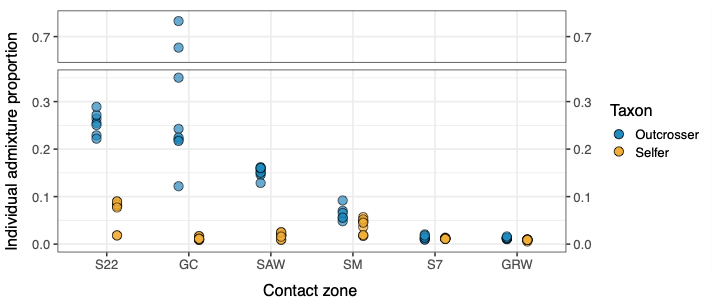
We sequenced, assembled and annotated a reference genome for Clarkia xantiana, and used whole-genome-sequencing on 200 individuals to infer population structure in the two taxa and quantify introgression in multiple contact zones in the region of sympatry. We found extensive variation in introgression – both between taxa and among contact zones. Introgression was largely asymmetric, with more introgression from the outcrosser to the selfer than the reverse. Across contact zones, there was variation in introgression into the outcrosser, ranging from none to nearly 20% of the genome being introgressed from the selfer. We found that this variation was largely explained by variation in interannual spring precipitation. Contact zones with higher variance among years in spring precipitation had higher admixture proportions. We hypothesize that there is greater flowering time overlap between the taxa in any given year, which is a strong premating barrier and can also be plastic, in sites with higher variance in interannual spring precipitation. More broadly, our results suggest that variance in climatic conditions, which are hypothesized to increase with climate change, may result in increased opportunities for hybridization and introgression via the breakdown of reproductive barriers. Check out this paper here!
 The Sianta Lab